
AI large scale code verification
AI code verification.
Plan for scale.
A practical field guide to verifying AI-generated code across a growing repository. Choose checks that produce evidence your team can review.
Start with the job
What are you trying to verify?
An AI-assisted change
Check behavior, security and interactions beyond the diff before you merge a pull request.
Read the workflow ↗02 / EVALUATION TEAMSMany generated programs
Choose execution limits and judges for code evaluation workloads. A pass depends on the oracle.
Explore ScaleBox ↗03 / CRITICAL LOGICA precise property
Express preconditions, postconditions and invariants when a proof-oriented approach fits the problem.
Understand formal methods ↗Research in context
Scaling execution starts with defining a correct answer.
ScaleBox studies code evaluation infrastructure for language-model training. Its architecture separates execution from result verification, including special judges for tasks with more than one acceptable output.
That is a different job from deciding whether a pull request belongs in your application.
Read the research notes ↗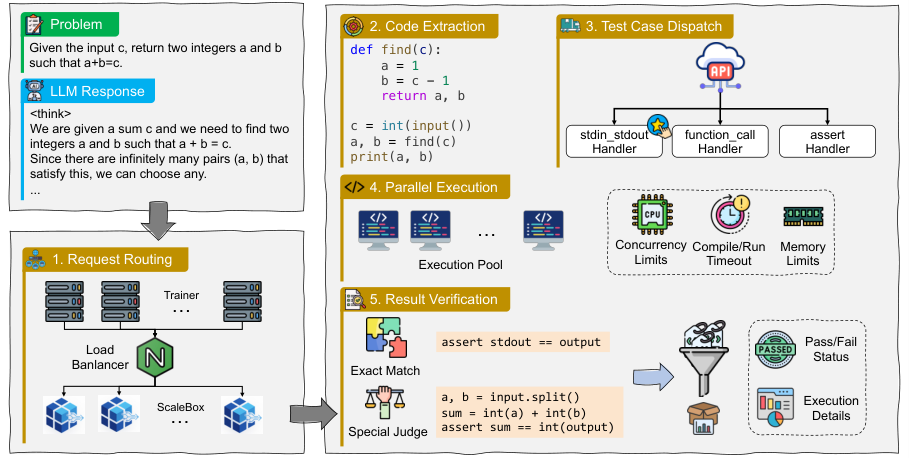
A usable review loop
Keep the evidence close to the change.
Write the property.
“An expired token cannot change a billing address” gives the reviewer something concrete to check.
Try to break it.
Cover rejection paths, boundary values and the callers that depend on the changed behavior.
Record the evidence.
Attach commands, results and known gaps. Require an owner to accept the remaining risk.
Review the findings
Find the alert that needs a decision.
GitHub’s code-scanning view lets a team narrow a finding list by tool, rule and severity. Inspect the relevant branch and analysis context before deciding what a finding means for a change.
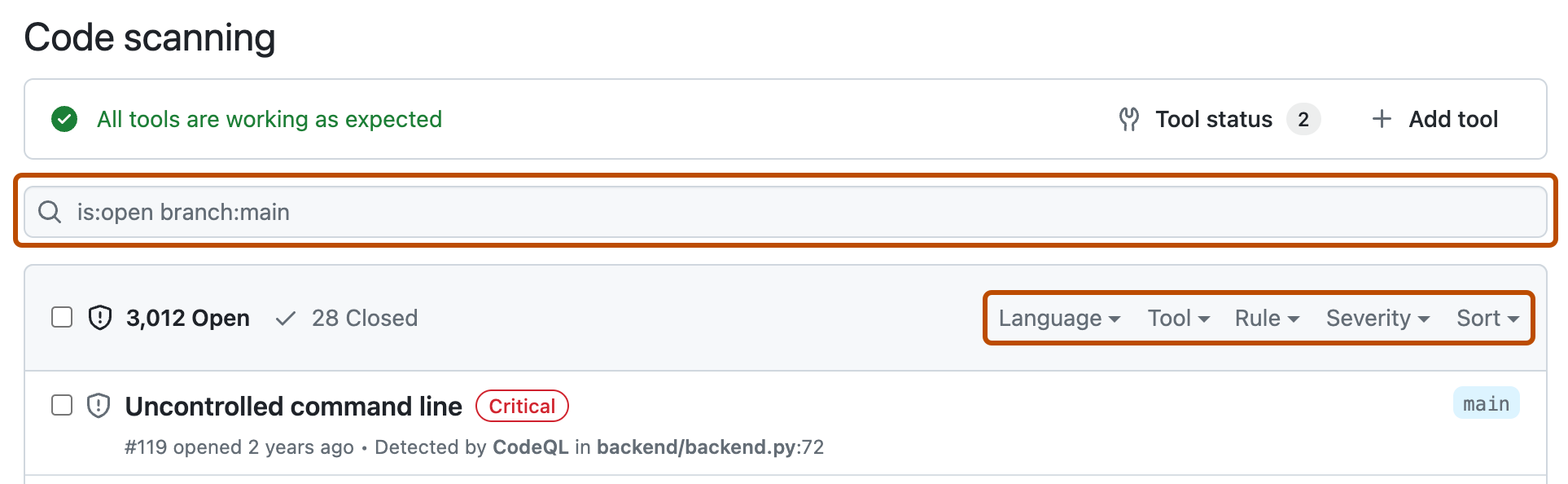
The screenshot is a published GitHub documentation example. This website does not scan repositories or report alert counts.
Give the next change a clear path.
Choose your stack. Get a reviewable verification plan.